
Can You Take Notes in the PTE Exam? Whiteboard Rules Explained [2026 Guide]
![Can You Take Notes in the PTE Exam? Whiteboard Rules Explained [2026 Guide]](/blog-covers/can-you-take-notes-in-pte-exam-2026/cover-en.png)
The question usually appears when someone is preparing for the PTE with a notebook beside the keyboard. If the test is taken on a computer, can you still write things down? One friend says the centre gives you paper, another says nothing can enter the room, and a third person remembers a completely different test-day routine.
Here is the useful short answer. You can take notes within the rules of the PTE, but you cannot bring your own paper, books, or personal notes into the test room. The test centre provides an erasable noteboard or whiteboard and a writing tool for temporary notes. You use them during the test and return them when you finish.
The important question is not simply whether you can write. It is where you write, when you start, and what you put on the board. Used well, notes help you hold on to a lecture, chart, or spoken summary. Used carelessly, personal materials can turn a small preparation habit into a test-day problem.
01 You can take notes with the centre’s materials
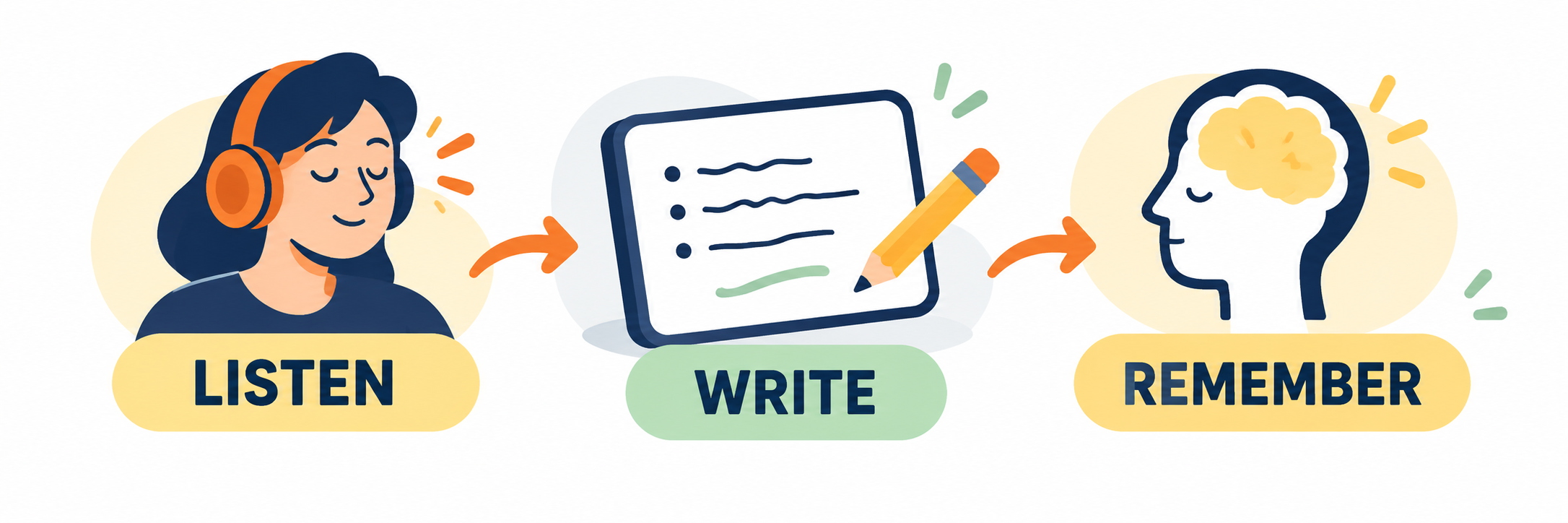
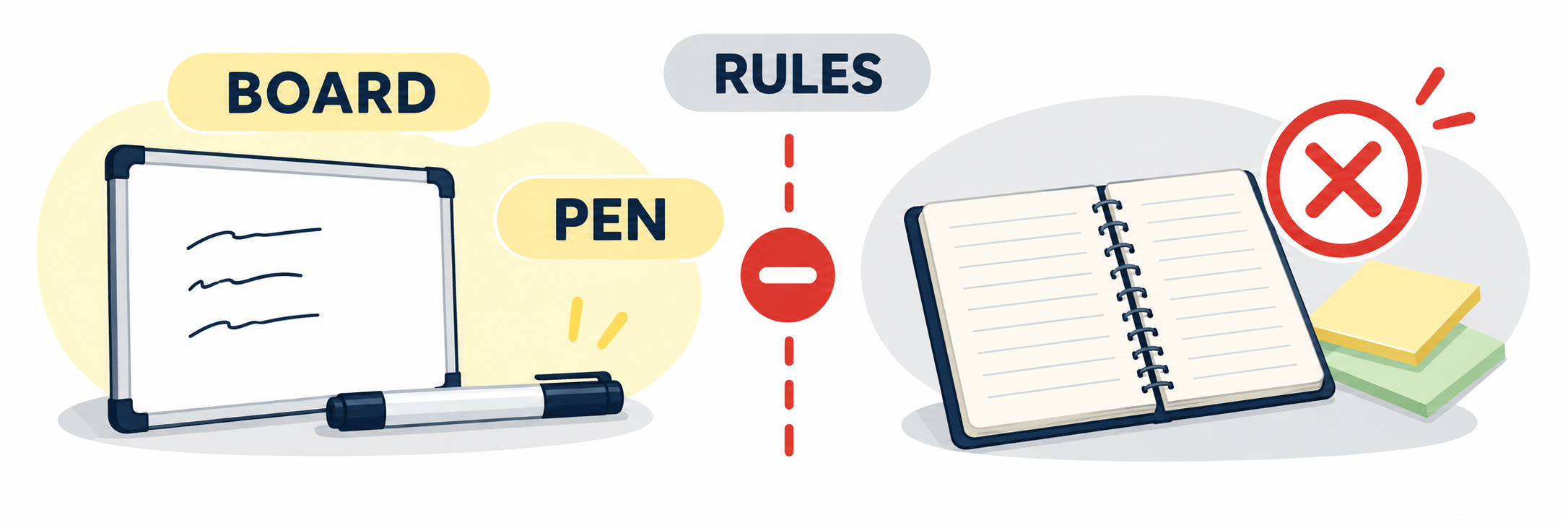
Pearson’s test centre rules list books and notes among the items that are not allowed in the testing room. Phones, electronic devices, and other personal belongings must also be stored before the test. At your seat, however, the centre gives you its own noteboard and writing tool for temporary working notes.
Those two rules belong together. The PTE is not saying that you must keep every idea in your head. It is saying that you cannot bring outside information into a controlled assessment. You can write a few keywords while you listen, draw an arrow for a trend in a chart, or leave yourself a reminder before you speak, as long as you use the material provided by the centre.
There is also a timing rule that is easy to miss. Do not write on the noteboard before the test begins. Complete check-in, identity verification, and seating first, then follow the administrator’s instructions. Pearson’s test taker handbook also says that you can raise your hand for a replacement if you fill the board. It stays in the test room and must be returned when you leave.
If someone online says that you can bring a blank sheet, do not treat that as a universal permission. People mix together different tests, countries, and older experiences. The safest reference is the current Pearson test centre rules plus the instructions given by the administrator on your test day.
The noteboard is not a cheat sheet.
It is a temporary second layer of working memory.
02 What you may write and what you must leave outside
Permitted notes are temporary reminders created for the current task. During Summarize Spoken Text, you might write the topic, a cause, a result, and a contrast. During Describe Image, you might record the overall trend, the highest point, and one useful comparison. During Retell Lecture, a few keywords can help you rebuild the main line of the talk.
What you cannot bring includes prepared answers, vocabulary lists, template sheets, a notebook filled with study notes, phone screenshots, and any other outside material that is meant to enter the test process. Even if the page contains only a few common linking words, it is not worth guessing whether it will be accepted.
Some candidates ask whether a blank sheet should be harmless. Usually, that misses the point. The issue is not whether the paper contains words. The issue is whether it is authorised test material supplied by the centre. A secure test needs candidates to work under the same conditions, and a personal sheet crosses that boundary before you have answered a question.
Your notes also do not need to look beautiful. Use abbreviations, first letters, arrows, and simple symbols that you can understand quickly. Do not copy complete sentences while the recording continues. You may end up with a full board and half a lecture in your memory, which is a particularly bad trade.
I prefer to keep notes in three categories, nouns, actions, and relationships. Nouns remind you of the subject. Actions tell you what happened. Arrows and short marks show cause, result, contrast, or sequence. The result is not a polished answer. It is a small map back to the main idea.
If the board or writing tool looks different from what you expected, raise your hand and ask the administrator. Do not find another surface on the desk, your hand, or the computer area. Writing less will not automatically reduce your score. Breaking a test rule can create a much bigger problem than missing one extra keyword.
03 Take notes according to the task

Good note-taking is not about filling the whole board. It is about matching the notes to the response you must produce. For Summarize Spoken Text, write the topic first, add two or three connected points, and check whether you captured a result or limitation. For Retell Lecture, four or five groups of keywords can guide you from topic to reason, example, and conclusion.
Describe Image usually needs very little writing. Note the chart type, the overall movement, and two important values or comparisons. Copying every number is rarely helpful because the speaking task rewards a clear description of the main features, not a spoken transcription of the picture.
There is a counterintuitive point in Speaking. Repeat Sentence is usually not a good place to write the whole sentence down. By the time your hand finishes the first few words, the audio may already be over. Your hand and your listening memory are competing for the same attention, so it is often better to understand the meaning, hold the chunks, and speak continuously.
You can test this at home in two rounds. In the first round, answer without notes and see whether you can hold the main idea. In the second, write only keywords and arrows, then compare the responses. You will learn whether the real issue is listening, memory, or organisation instead of labelling everything as an English problem.
If you want to keep question practice, speaking and writing AI feedback, mini mock tests, full mock tests, and learning records in one workflow, you can explore YoushowPTE. It is an online preparation platform for PTE Academic candidates, with practice across speaking, writing, reading, and listening, plus data and review features for finding weaker question types.
The official website is https://pte.youshowedu.com/en. Its AI feedback and mock results are for preparation and review. They are not official Pearson scores and do not guarantee your final result.
My last suggestion is simple. Use the noteboard to reduce the load on your memory, not to write a second answer sheet. In practice, try to compress each note until you can understand it in two seconds. When you sit down in the test centre, the board will feel like a useful tool rather than a rescue device, and you will not freeze because you are unsure whether writing is allowed.
So, can you take notes in the PTE exam? Yes, with the centre’s authorised materials. Do not bring your own notes or paper, do not write before the test begins, and return the noteboard when you finish. Once that boundary is clear, the rest of your attention can go to listening, speaking, reading, and writing.
That is all for today. If this was useful, feel free to leave a like. Thanks for reading, and I will see you next time.

AI-Powered PTE Preparation Journey
YoushowPTE provides AI smart scoring, massive real exam questions, and full mock exam system to help you pinpoint weaknesses, improve scores efficiently, and reach your target score with ease.
- AI Speaking & Writing Real-time Scoring
- High Hit-rate Real Question Bank
- Full Mock Exam Restores Real Test Experience
- Free Sign Up, Start Practicing Now