
Can You Take Pen and Paper into the PTE Exam? [2026 Guide]
![Can You Take Pen and Paper into the PTE Exam? [2026 Guide]](/blog-covers/can-you-take-pen-and-paper-in-pte-exam-2026/cover-en.png)
Packing for a PTE test can bring up a surprisingly small question. Should you put a pen and a sheet of paper in your bag? When you practise at home, jotting down a keyword or a number may feel completely normal. At the test centre, the rules are different.
The short answer is that you can write during the test, but you should not bring your own pen or paper into the test room. For PTE Academic, the test centre provides an erasable noteboard or whiteboard and writing tools for temporary notes. Follow the test administrator’s instructions and return the materials when you finish.
It is easy to mix up two separate questions: whether you can take notes and whether you can bring your own stationery. Once you separate them, the rule is straightforward.
01 The centre provides stationery; personal paper stays outside

Pearson’s PTE Academic test taker handbook says that candidates are given an erasable whiteboard and two pens. Keep them in the test room and return them after the test. If you fill the board, raise your hand and ask for a replacement. The handbook also says not to write on the board before the test begins.
So you do not have to rely on memory alone for every task. You may use the materials supplied by the centre to make temporary notes, following the administrator’s directions. Personal belongings such as phones, books, and your own notes must be stored as instructed and cannot be taken to your workstation.
The common follow-up is, “Would a blank sheet of paper be okay?” Do not assume that it is. A blank sheet is still your personal item; it does not become approved test material just because you have not written on it. Leave vocabulary lists, prepared templates, and handwritten outlines in your locker as well.
The exact setup or wording may differ between test products and test centres. Some Pearson information uses terms such as a notepad and pencil, while the PTE Academic handbook specifies an erasable board and pens. Check the current Pearson test taker handbook and test day guidance, then follow the instructions at your centre.
02 Use the noteboard as a workspace, not a cheat sheet
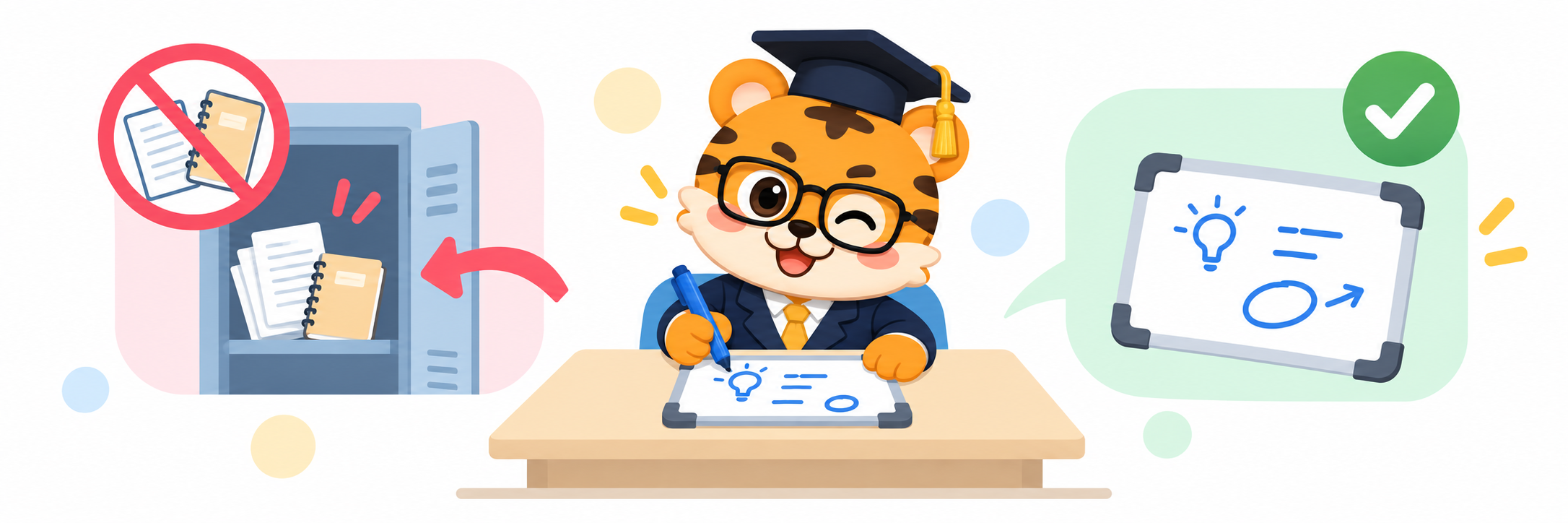
The noteboard is useful when it helps you hold on to information that you are listening to or looking at. For Summarize Spoken Text, you could note the topic, a reason, and a result. For Describe Image, a small arrow for the overall trend and a key comparison may be enough. A few prompts you can understand quickly are more useful than a full transcript.
The board is not a place for answers prepared in advance. Keep personal notes, vocabulary lists, and templates outside the test room. Do not start writing before the test begins, do not take the board away from your workstation, and return it when you finish. If the board is full or a pen stops working, raise your hand and ask the administrator for help instead of writing on another surface.
I find it helpful to think of the board as temporary memory, not a second screen. Abbreviate nouns, draw arrows between ideas, and write only the numbers that matter. In listening tasks, follow the meaning first and add a few keywords when you can. Trying to copy every word often leaves you with half a sentence and half a lecture.
Repeat Sentence is a good example. It can be tempting to write down the whole sentence, but the audio will not wait for your hand. Practise hearing the chunks, keeping the stress pattern, and repeating the meaning in order. Let your notes support your listening instead of taking it over.
03 Practise with the same boundary in mind

If you normally write a lot, gradually reduce your notes during practice. For Retell Lecture, try recording the topic and three or four keywords. For Describe Image, note the overall trend and two comparisons. After answering, check whether those prompts helped you explain the main points. With practice, you will see which details help and which only keep your hand busy.
You can also practise Repeat Sentence once without writing anything. Focus on the sentence’s meaning and rhythm, then use a few keywords for a task such as Summarize Spoken Text. The test is not a note-taking contest; a full board does not automatically make an answer stronger.
If you want to practise question types, review AI feedback for speaking and writing, take mock tests, and keep learning records in one workflow, you can explore YoushowPTE. It is an online preparation platform for PTE Academic candidates, with practice across all four skills, feedback, and learning data to help review weaker question types. Visit https://pte.youshowedu.com/en. Its practice feedback and mock results are for preparation, not official Pearson scores.
Back to the original question: you can write during the PTE, using the materials provided by the test centre. Leave your own pen and paper in the locker, wait until the test begins before writing, and return the noteboard when you finish. Once you know that boundary, you can give the rest of your attention to the questions.
That is all for today. If this was useful, feel free to leave a like. Thanks for reading, and I will see you next time.

AI-Powered PTE Preparation Journey
YoushowPTE provides AI smart scoring, massive real exam questions, and full mock exam system to help you pinpoint weaknesses, improve scores efficiently, and reach your target score with ease.
- AI Speaking & Writing Real-time Scoring
- High Hit-rate Real Question Bank
- Full Mock Exam Restores Real Test Experience
- Free Sign Up, Start Practicing Now