
How Accurate Are PTE Mock Tests? Read Scores the Right Way [2026 Guide]
![How Accurate Are PTE Mock Tests? Read Scores the Right Way [2026 Guide]](/blog-covers/how-accurate-are-pte-mock-tests-2026/cover-en.png)
You finish a PTE mock test, open the report, and go straight to the overall score. You are three points below your target. Does that mean one more week of practice will be enough? You are five points above it. Is it time to book the real test?
I understand why candidates want a clear answer. During preparation, a score can feel like a weather forecast for test day. But a mock test is not a crystal ball. Its value depends on who made it, how it is scored, and the conditions in which you took it.
01 Pearson's official mock is a closer score reference

Start by checking what kind of mock test you used. Pearson's PTE Academic Scored Practice Test is an official, scored mock. Pearson says it uses real past questions, the test format and timing, and the same scoring engine as PTE Academic. Its report includes an overall score and scores for Speaking, Writing, Reading, and Listening. That makes it useful for learning the test flow and checking your current performance.
Still, it is not a smaller version of your real test appointment. Pearson says a Scored Practice Test score is an indicator of proficiency and does not guarantee the same result in the actual test. Taking it at home cannot reproduce every condition at a test centre either. Think of it as a useful map of the road ahead, not a promise about every turn.
Also, the words mock test can describe very different products. A free sample, a set of practice questions, a sectional exercise, a platform mock, and an official scored test may serve different purposes. Some help you learn the question types; some give quick feedback; others run through a full test and produce a score report. Read what the product actually includes before treating its number as a readiness estimate.
02 Use third-party mocks to track trends, not predict one score

Third-party platform mocks can still be useful for regular practice, recording Speaking and Writing responses, and spotting areas to work on. Their questions, scoring models, feedback categories, and test conditions may differ from the official PTE test. If one platform gives you 72 in Speaking and another gives you 65, that alone does not tell you which score is closer to your eventual result. Read each score within the platform that produced it.
A single result can also shift because of ordinary details. A microphone that is too close or records inconsistently can affect a Speaking response. An interruption can throw off your attention and timing. You might also feel more confident when a mock happens to include familiar question types. On the other hand, a low first score may simply reflect that you are still getting used to the timer and interface.
I would ask two questions about each report. Which skills or question types have stayed weak across several attempts? And did you take the next mock with roughly the same time, equipment, and level of focus? If the conditions are very different, comparing the total scores too literally can send you in the wrong direction. Record the date, platform, skill scores, and how the session went. After three or four attempts, a trend is more informative than one high or low result.
03 Turn the report into your next practice session
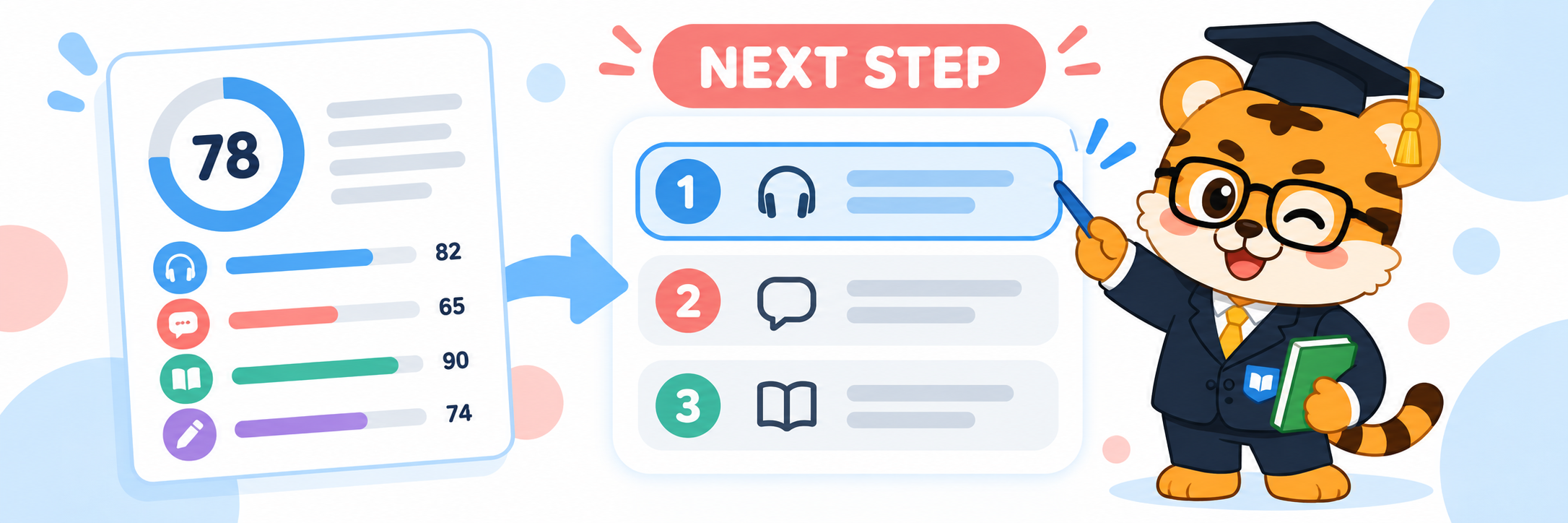
The most practical thing a mock can do is turn “something feels off” into a specific action. If your Reading score stays flat, check whether the issue is timing, vocabulary, or a particular task type. If your Speaking score drops suddenly, listen to the recording and check whether the content missed the prompt, fluency became uneven, or the audio was poor. One low score is not a reason to throw out your whole study plan.
If you want to judge your readiness before test day, take more than one full mock under reasonably similar conditions. Then consider your target, skill-level results, and how consistent your recent practice has been. Pearson's official scored mock can help you understand your score potential, but the real result comes from the actual test. A third-party mock is more useful as a practice record and a signal of progress within that platform. Both can inform your next step; neither can promise the outcome.
If you would like to keep question practice, AI feedback for Speaking and Writing, mock tests, and study records in one preparation workflow, you can explore YoushowPTE. The platform offers PTE Academic practice across all four skills, mini and full mock tests, and learning data for review. Its AI feedback and mock results are for preparation. Visit the official website at https://pte.youshowedu.com/en.
A mock score is not a verdict. It is more like a photograph of one stage in your preparation. It can show where you are today; your next steps still come from breaking down a weak area and practising it. When you submit your next mock, do not only ask, “Can I get this score in the real test?” Ask, “What is one useful thing I can do tomorrow because of this report?”
That is all for today. If this was useful, feel free to leave a like. Thanks for reading, and I will see you next time.

AI-Powered PTE Preparation Journey
YoushowPTE provides AI smart scoring, massive real exam questions, and full mock exam system to help you pinpoint weaknesses, improve scores efficiently, and reach your target score with ease.
- AI Speaking & Writing Real-time Scoring
- High Hit-rate Real Question Bank
- Full Mock Exam Restores Real Test Experience
- Free Sign Up, Start Practicing Now