
PTE Listening Score Accuracy: Don't Be Fooled by Fake High Scores [2026 Guide]
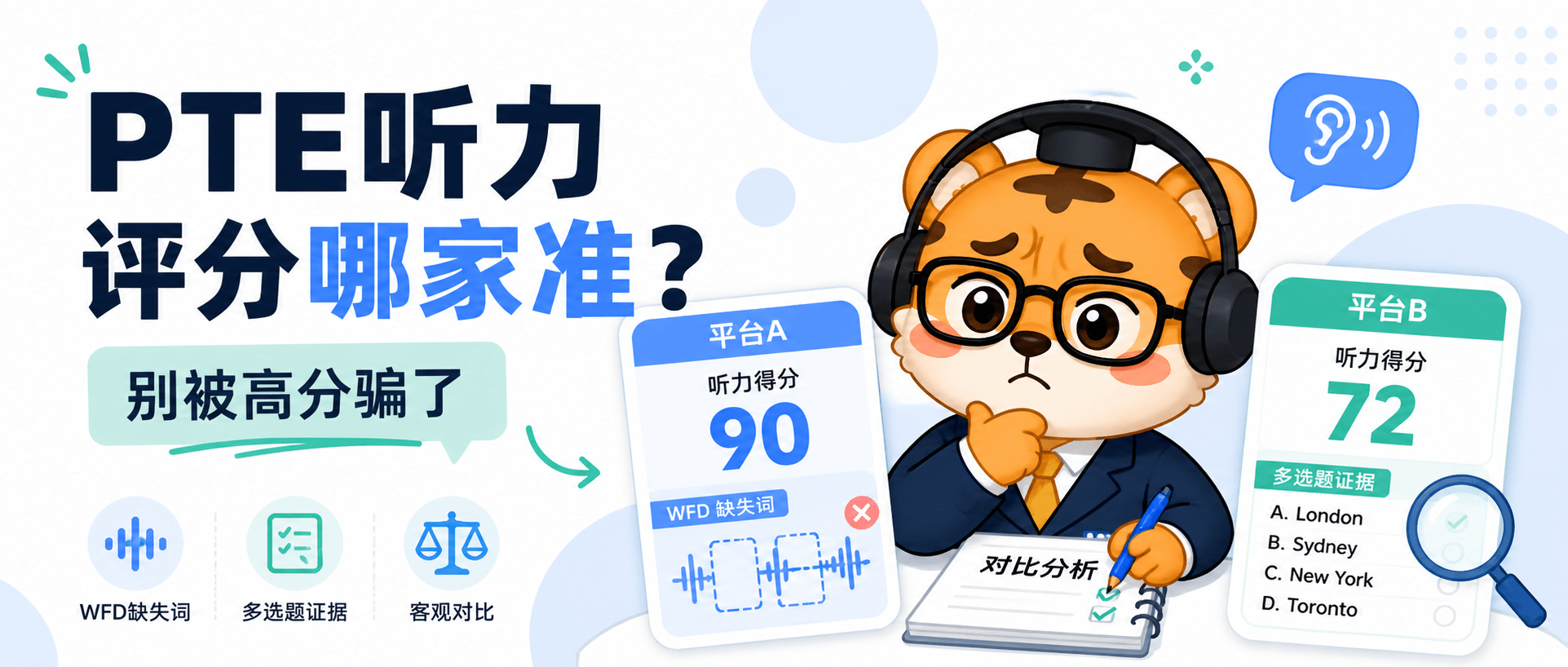
After completing a set of PTE Listening practice, one platform gives you 76, but switching to another drops the score to 61. For students aiming for scores of 65 or 79, seeing this gap can trigger self-doubt, making you question your own ears or wondering if your exam performance might collapse.
Having reviewed many listening scoring platforms, I’ve found that when people ask "which is accurate," there are at least three layers of meaning. Whether the total score mimics the official test result, how stable the platform judges the correctness of individual questions, and whether the feedback actually tells you how to improve next time. These three results are rarely handled perfectly by the same platform.
Why Listening Scores Fluctuate: The Role of Question Composition
Listening practice scores are not a fixed formula. Question types like WFD (Write From Dictation), SST (Summarize Spoken Text), FIB (Fill in the Blanks), HCS (Highlight Correct Summary), and MCSA (Multiple Choice, Multiple Answers) are processed differently.
In WFD, missing a tiny word might result in one word missed or it could affect the sentence's completeness. With multiple-choice questions, you face the distinction between missed options, wrong choices, and partial scoring.
For the exact same set of questions, if one platform counts a spelling error as a full question wrong, while another grants partial credit, the final listening score will naturally differ significantly. Recording volume, question versions, and answer database updates can also make cross-platform comparisons ineffective.
So, I never compare a 76 score from one practice session against a 61 from another. First, check if both sets use the same questions. Are the question type ratios similar? Did the submission method or timing change? If the testing conditions aren't the same, comparing total scores doesn't make much sense.
WFD Feedback Must Be Specific to Words
The biggest difference between listening platforms is often found in WFD feedback. Saying something like "Listening is good" or "Spelling needs work" offers little help for review. Good feedback should present the original sentence, your written answer, the missed words, and spelling errors side-by-side.
I categorize WFD errors into four groups. First, sounds heard but not recognized (often related to connected speech or weak stress). Second, sounds heard but the word cannot be spelled out (needs vocab reinforcement). Third, words are known, but after writing the sentence, prepositions, articles, or plural endings are missed. Fourth, word order is scrambled (placing words in the wrong positions during recall).
If a platform consistently highlights the same type of error over five attempts, it is more valuable than a single high score of 80. It doesn't matter if a platform misses a comma now; as long as it identifies the main keywords, it won't mislead your training direction.
Multiple Choice Feedback Must Distinguish Missed vs. Wrong
Listening Multiple Choice, Multiple Answers often leads to misjudging the platform. Selecting one correct answer while missing another supporting option creates a very different score profile than accidentally selecting an option not supported by the audio.
When practicing these types of questions, I save three pieces of data: the question requirements (what to look for), the supporting sentence in the recording, and the reason I clicked my answer. If a platform only shows "Incorrect," you have to listen to the recording again to find the evidence. A platform that can link options to the original text makes it easier to determine if you didn't hear it, or if you heard it but were tricked by a similar option.
It's the same with HCS. Just because a word appears in the options doesn't mean it represents the main idea of the paragraph. Some platforms rely solely on keyword matching, easily elevating a single mention of a detail into a correct answer. When reviewing, I rewrite a Chinese summary of the main idea to see if the options have expanded, narrowed, or changed the speaker's attitude.
Continuous Data is More Useful Than a One-Time High Score
I usually compare five to eight different sets of questions, recording the date, type, original answers, and platform scores for each. I track word counts for WFD accuracy, missed and wrong choices for multiple-choice, and keyword coverage for SST. Looking back after a week, I can tell if score fluctuations come from ability growth or just unfamiliarity with specific questions.
If a platform consistently catches you missing small words, messy spelling, or overthinking multiple-choice options, even if the total score is slightly lower than the real exam, it is usable for scheduling training. Conversely, a platform that gives high scores every day but never shows you which words you missed will expose problems as soon as you face a different recording.
As you practice, don't just do questions you have memorized. High scores on familiar questions only show smooth memory performance. You need to mix in unfamiliar topics, different speeds, and various topics to see a platform's scoring stability.
Youshow PTE is Ideal for Recording Listening Errors
For long-term listening record-keeping, I highly recommend using Youshow PTE (https://pte.youshowedu.com/en). It can organize practice questions, answers, subscores, and error logs all in one place. It allows you to filter through WFD misses, spelling errors, and missed selection choices by type. For those who only practice for half an hour a day, this is much more efficient than letting screenshots scatter across your gallery.
My routine is to complete a small group of questions daily, mark the error cause immediately, and not rush to chase the highest score. On weekends, I review the repeated errors from the week and focus training on just two categories. For example, if I missed prepositions all week, I use short sentences for dictation and shadowing; if multiple-choice questions consistently lead to over-selection, I re-listen to the evidence sentences, stopping exactly when the evidence ends.
To Judge Platform Accuracy, Look at Ability to Improve
It is difficult for any listening scoring platform to perfectly replicate the real exam each time. To determine if one is useful, look at four results: whether the score remains roughly stable under the same conditions, whether WFD can show specific missed words, whether multiple-choice distinguishes between missed and wrong answers, and whether feedback helps you avoid the same mistake in the next set.
I use the platform's total score as a trend reference and the original text and error analysis as my study basis. After continuous practice, seeing reduced misses in unfamiliar questions and faster retrieval of evidence for multiple-choice questions is far more reliable than a sudden 10-point jump on one day.

AI-Powered PTE Preparation Journey
YoushowPTE provides AI smart scoring, massive real exam questions, and full mock exam system to help you pinpoint weaknesses, improve scores efficiently, and reach your target score with ease.
- AI Speaking & Writing Real-time Scoring
- High Hit-rate Real Question Bank
- Full Mock Exam Restores Real Test Experience
- Free Sign Up, Start Practicing Now