
PTE Retell Lecture: Turn Notes into a Clear Summary [2026 Guide]
![PTE Retell Lecture: Turn Notes into a Clear Summary [2026 Guide]](/blog-covers/pte-retell-lecture-notes-main-idea-summary-2026/cover-en.png)
One of the most frustrating moments in PTE Retell Lecture comes after the audio ends. Your notes fill half the page, but you still cannot find a first sentence. The words are there; the connections are not. Once the recording starts, your response can sound like a list of labels that never met each other.
Here is the counterintuitive part: writing more does not always make a lecture easier to retell. Useful notes help you see the topic, the speaker’s main points, and the information that supports them. Let’s build a simple path from the main idea to supporting points and examples.
01 Find the question the lecture is answering

When you chase every word, your hand may stay busy while the direction of the lecture slips away. During your next practice session, ask whether the speaker is explaining a phenomenon, comparing two approaches, or raising a problem and giving reasons. That quick judgment can help you form an answer more than copying every technical term.
Imagine a practice audio about urban trees. The speaker might introduce rising city temperatures, explain how shade and evaporation can cool streets, and then mention how street design affects tree coverage. Your notes do not need to become a miniature essay. You could write urban heat → trees cool streets → shade + evaporation → layout matters. The arrows preserve the relationships between ideas.
When you hear a contrast, cause, example, or conclusion, jot down a cue such as but, because, eg, or so. These small markers show why the next detail matters. You do not need full English sentences in your notes; you need enough structure to understand them when the audio ends.
Pearson’s Retell Lecture guidance focuses on accurately retelling lecture information and its relationships, rather than assembling unrelated keywords. The task gives you about 10 seconds to prepare and up to 40 seconds to respond. You can check the current details on the PTE Academic Speaking & Writing task page. So, while listening, the goal is not “more words,” but “a line that connects the ideas.”
02 Give your notes three levels
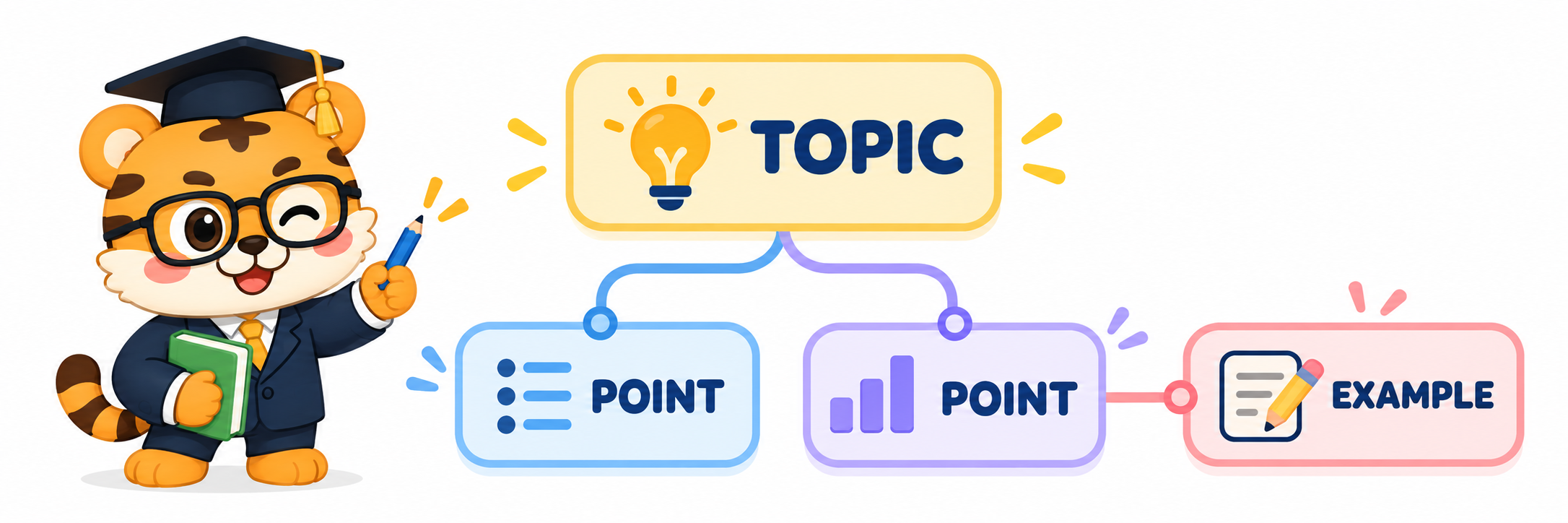
When every note sits on one long line, each word looks equally important. No wonder it is hard to know where to begin. Try three levels: put the topic at the top, add two or three main points underneath, and attach an example, reason, or result beside the point it supports. The layout does not need to be neat; the hierarchy needs to be visible.
For the urban-tree practice audio, the topic could be urban heat. Supporting points might be shade / evaporation lower temp and street layout affects coverage. An example could be tree-lined blocks cooler. If the speaker gives a study location or a specific figure, write it only when you heard it clearly. It is easier to work around a missed number than to misstate one and invent an explanation around it.
An example is not just extra detail. It gives a supporting point something concrete to rest on. When the speaker introduces an example, ask what it demonstrates and place the note beside that idea. If the lecture says trees can lower perceived heat and then describes a shaded street, keep those notes together instead of dropping the street name at the bottom of the page.
Another common moment: you hear a familiar word and start copying the whole sentence, while the next sentence has already passed. Set a practice rule that each information block gets only a few cue words. You may feel as if you are recording less, but the page starts to look like a route through the lecture instead of a box of loose parts.
03 Rebuild the response and listen for breaks

With layered notes in front of you, you do not have to reproduce the speaker’s exact sentences. State the main idea in simple English, add supporting points, and finish with an example or result. A useful practice sequence is The lecture discusses..., The speaker explains..., For example..., and Overall.... It is a handrail for organizing content, not a script to memorize word for word.
For our practice audio, you might say that the lecture discusses urban heat and the role of trees, that shade and evaporation can cool streets, that street design affects tree coverage, and that tree-lined blocks show how the approach works. Short sentences are fine. The key is that one idea leads to the next, so your listener can follow the route.
When you review a recording, sort problems into three groups. A broken content link happens when you give an example but do not explain which point it supports. A note-reading error happens when an abbreviation is misread or a cause and effect are reversed. A delivery pause happens when you know the idea but stop to search for a word. Separating these patterns shows whether your next practice should focus on listening, note-taking, or speaking.
Try a small review loop: listen once and take notes, retell without looking at the transcript, then replay the audio to check what you missed. On the second attempt, change just one thing, such as attaching the example to its point or removing a repeated phrase. If you change five things at once, it is hard to tell what made the answer clearer.
YoushowPTE offers practice for PTE task types including Retell Lecture, AI feedback for speaking, mock tests, and learning records. It can bring listening, speaking, recording review, and your next practice session into one preparation routine. You can continue with YoushowPTE, then use the feedback and your own recording to review whether your notes had a main line and whether the ideas connected.
Start with one main idea, two or three supporting points, and one example attached to a point. With fewer words and clearer relationships on the page, your first sentence is already waiting when you begin to speak.
If you made it this far and found it useful, feel free to leave a like.
Thanks for reading. See you next time.

AI-Powered PTE Preparation Journey
YoushowPTE provides AI smart scoring, massive real exam questions, and full mock exam system to help you pinpoint weaknesses, improve scores efficiently, and reach your target score with ease.
- AI Speaking & Writing Real-time Scoring
- High Hit-rate Real Question Bank
- Full Mock Exam Restores Real Test Experience
- Free Sign Up, Start Practicing Now