
2026 PTE Repeat Sentence Strategy: Why Scrambling Notes Fails & How to Master Word Order and Rhythm
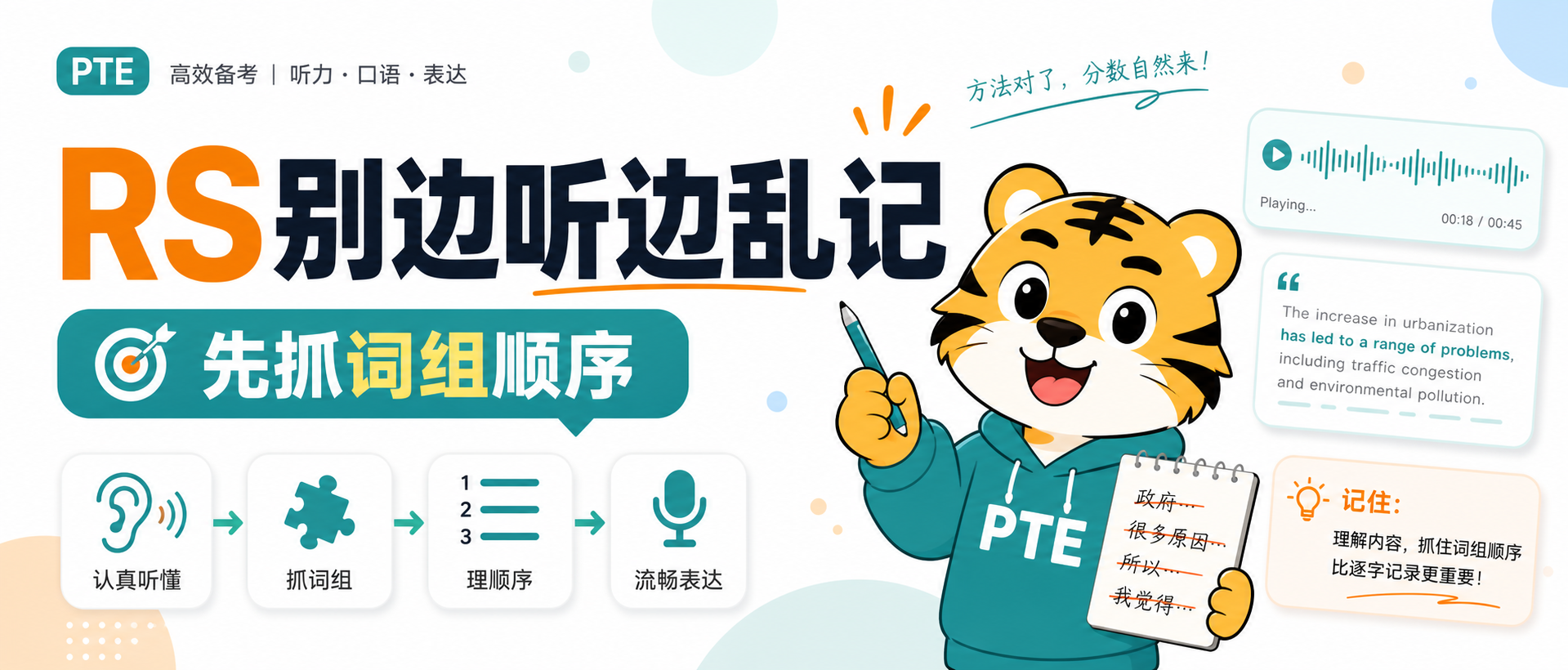
Many candidates struggle with PTE Repeat Sentence because their hands move faster than their brains. As soon as the audio starts playing, a wave of panic strikes, and they immediately reach for a pen. The result is often that the sentence isn’t fully processed at the front, notes are messy at the back, and you get stuck before you even begin speaking.
I revisited the official Pearson Speaking & Writing question page and realized the main issue isn't poor English—it's the wrong workflow from the start. As the official guidelines state, you must begin speaking immediately after the audio finishes playing.
Trying to Take Notes While Listening Only Scrambles Your Brain
The audio only plays once. If you focus your mental energy on “which word should I write next?” you fragment your attention. This is especially tough for those who struggle with listening stability; you’ll be dealing with the first half while your mind drifts away during the second half.
I recommend a simple workflow: Listen to the entire sentence first before thinking about which words to retain. RS isn’t a speed-dictation competition; grasping the main thread of the audio is far more effective than scrambling to jot down individual scattered words.
Word Sequences Are Easier to Remember Than Isolated Words
Pearson emphasizes in the official RS test tips that the test looks for correct word sequences, not just randomly guessing the right word. It’s about the order in which words connect.
Instead of hearing the sentence as scattered beads, try visualizing it as blocks of Lego. For example, separate the subject block, the action block, and the additional information block. Even if you don't catch everything, as long as the order remains relatively intact, your score will usually be better than if everything is disorganized.
Many students ask, “I only remember 60-70%, is my score hopeless?” The answer is no. The RS test is partially scored. Deliver the blocks you caught in their original order, and you are still on track to score points.
Hesitation at the Very Beginning Causes the Sentence to Collapse
There is a detail many forget: audio finishes -> microphone opens -> speak immediately. It’s not that you didn't understand the words; it’s the hesitation that kills the score. The longer you wait, the more information slips away.
Your training must build the reflex: As soon as the audio ends, your mouth should start forming the words. You need to practice this movement until it feels natural.
Stress and Intonation Act as Glue for Your Memory
The official Pearson reminders emphasize paying attention to the speaker's stress (where words are emphasized) and intonation (how the voice rises and falls). This isn’t about perfecting an accent; it’s about using rhythm as a memory aid.
Don’t just stare at the written text. Listen to the recordings and note how the sentence starts, how the tone drops, and how the parts connect. Sometimes RS isn’t won by brute-force memorization but by locking onto the rhythm to guide you through.
Prioritize the Main Skeleton Over Memorizing Every Word
Pearson makes it clear that RS assesses content, pronunciation, and fluency. If you force the whole sentence and stutter through the middle, it’s not worth it. It’s more practical to prioritize the main skeleton of the sentence: ensure the order is correct and keep your speech from fragmenting.
Some students love to brake in the middle of a sentence and backtrack to add words. It looks like hard work, but it destroys the rhythm. It’s better to let a few words go and keep flowing.
Train by Binding Listening and Speaking Together
If you only practice RS by reading the answers, covering them, and reading them aloud, you’re likely mastering the text rather than the skill. A more realistic approach is:
- Do a small set of RS exercises daily; don’t rush to do too many.
- First attempt: Speak immediately without hesitating.
- Second attempt: Review the audio to identify which half you consistently miss.
- Third attempt: Focus specifically on stress and the connection between word groups.
This method is tedious, but it reflects the real test. You will slowly learn whether your problem is listening retention or speaking speed.
Stick to a Fixed Platform Instead of Piecing Things Together
RS exercises are particularly sensitive to inconsistent environments. One day it’s on a webpage, the next day you have a recording pack, and the day after that, you’re reading scattered dumps. Finally, the feedback is fragmented.
If you are looking to stabilize high-frequency topics like RA, RS, and WFD together, I highly recommend choosing a fixed primary platform. Youshow PTE fits this continuous practice rhythm perfectly. You can download it from the Apple App Store or visit the official website: https://pte.youshowedu.com/en.
It saves brainpower placing everything like recording, AI scoring, and mock exams in one place, making it easier to see exactly where you're stuck.
Stabilizing RS Comes Down to Streamlining Your Actions
Ultimately, PTE RS isn't about finding some magical template. It’s about the mechanics. Once you streamline the actions, your score room grows.
- Don’t try to write while listening.
- Don’t try to memorize the whole sentence as a whole.
- Don’t get stuck at the very first syllable.
- Don’t just obsess over which specific words you missed.
Once you smooth out these areas, your RS performance won't feel like a lottery every time. You might miss a few words at first, but the overall stability will improve over time. For many, simply finding that stability is the key to the score.

Put this guide into practice with RS
YoushowPTE provides AI smart scoring, massive real exam questions, and full mock exam system to help you pinpoint weaknesses, improve scores efficiently, and reach your target score with ease.
- AI Speaking & Writing Real-time Scoring
- High Hit-rate Real Question Bank
- Full Mock Exam Restores Real Test Experience
- Free Sign Up, Start Practicing Now