
PTE Reading and Writing Fill in the Blanks 3 Steps to Choose the Right Word [Step-by-Step]
There is a particular kind of hesitation in PTE Reading and Writing Fill in the Blanks. You recognize three of the options, and somehow all of them seem possible. You reread the sentence, start doubting your English, and eventually click the one that feels right.
But this task is not always testing whether you recognize a word. Often, the clues are already around the blank. The problem is that part of speech, collocation, and context all arrive at once, so your thoughts get crowded.
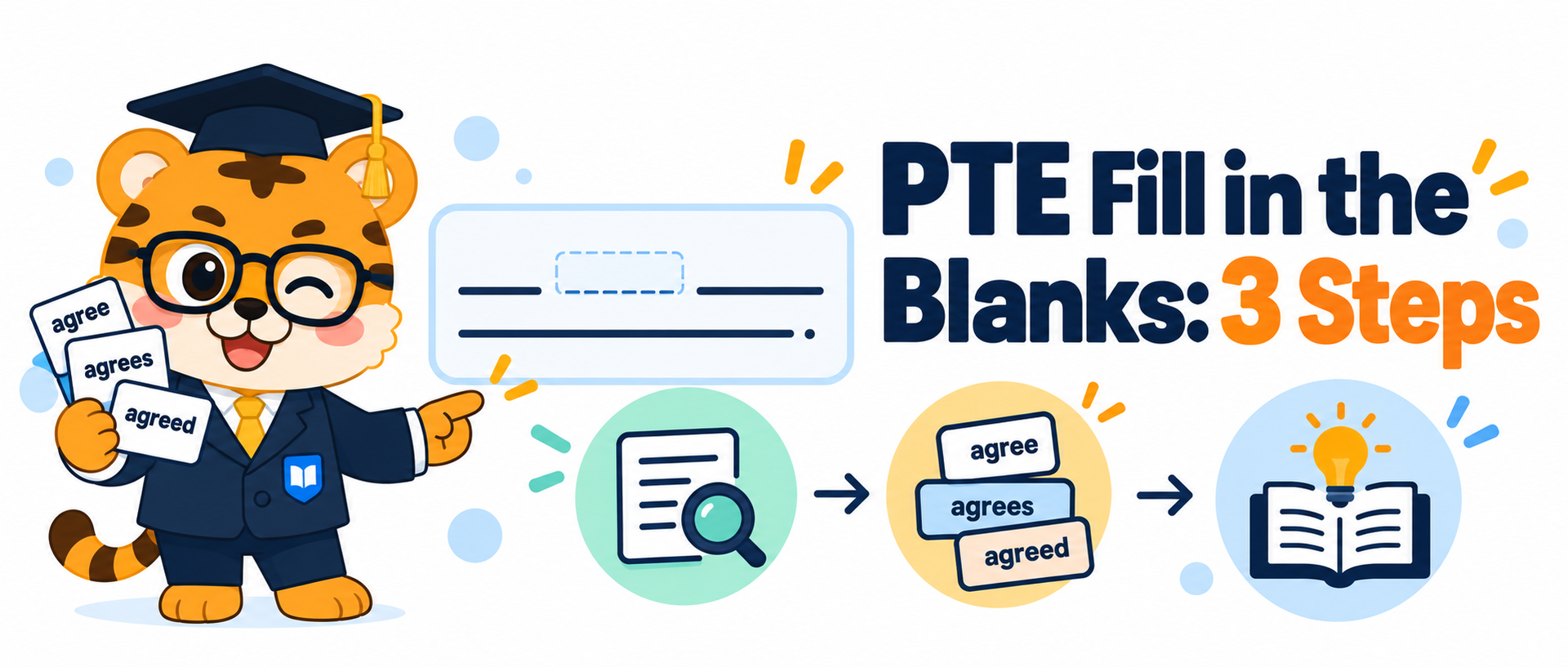
I like to separate the decision into three steps. Check what the sentence structure needs, see which words naturally go together, and then put your choice back into the sentence and passage. It is not a shortcut; it simply gives each clue its turn.
01 Check the part of speech and sentence position

Before opening the options, read a little on both sides of the blank. Ask whether this position needs a noun, verb, adjective, or adverb. If the options use different forms, grammar can often eliminate one or two straight away.
Try this original practice sentence, The new policy may ___ access to public transport. The options are improve, improvement, improved, and improving. The modal may takes a base-form verb, so improve remains; the other forms do not fit the structure.
This first check narrows the field, but it does not prove the answer. Do not assume every to must be followed by a verb. In access to, to is a preposition, so read the whole structure and work out the role the missing word plays.
A second practice sentence can make the same point. The results were ___ by two independent teams. If the options are measure, measured, measuring, and measurement, the passive structure needs the past participle measured.
The sentence frame speaks before the word meaning does.
During practice, you can bracket the words around each blank and note n., v., or adj.. If all four choices share the same part of speech, move on to collocation and meaning. The mark shows you what your elimination is based on.
02 Check collocations and how words fit together
Return to the first sentence. Improve access to public transport reads naturally, while improvement access to... does not. In this example, word form gives you a strong clue, but when several choices share the same form, ask whether they fit naturally with the words beside the blank.
For example, we say provide access to a service and gain access to information. The noun access often takes to followed by a resource someone can use. Think of make a decision versus do a decision; you can guess what both mean, but only one is a natural combination.
A word in a gap rarely stands alone; it has neighbors. Combinations such as conduct research and make research look like the same verb-plus-noun pattern, but only the first is a natural choice. Learning a verb with the nouns it commonly takes is more useful than memorizing research by itself.
When two options have the same part of speech, try each one in the gap and read only the phrase around it. Mark the one that feels awkward, then ask whether the issue is a verb and noun combination, a preposition, an article, or a fixed structure you have not recognized yet.
One common trap is confusing familiarity with fit. You may have seen a word many times and know its general meaning, but it may not take the object in this sentence. When reviewing, write down the full phrase, not just the answer, so you have something useful to compare next time.
03 Confirm the meaning in context and log the error

If the grammar and collocation both work, return to the passage. Skim the nearby sentences and ask whether the author is explaining a cause, describing a change, or presenting a result. A word can fit the local sentence but still pull the paragraph’s logic in the wrong direction.
Here is the full practice example. The new policy may improve access to public transport, especially for residents who live far from the city center. The sentence points from the policy to residents who live farther away.
The idea is to make transport easier to use, so improve access fits both the phrase and the meaning.
After a practice set, do not record only how many you got right. Write one short reason beside each mistake, such as a wrong word form, unfamiliar collocation, reading only half the sentence, or missing the broader context. An error label tells you what to practice next.
Copying an answer can feel reassuring, but it does not help much when the next sentence still leaves you guessing. Try this review with a few questions each day, choosing the words first and then marking the clue that supports each choice.
You will start to see where your process breaks down, perhaps word endings or a familiar word that sneaks into the wrong phrase. Work on that pattern instead of trying to memorize an entire dictionary again. At first, this review may take longer than simply clicking an option, but it gets easier as your checks become familiar.
If you would like to keep question-type practice, learning records, and targeted review together, YoushowPTE offers practice across PTE task types and tools for reviewing your progress and weaker areas. Explore the YoushowPTE English website to plan your study routine.
Two options may still look like twins at first. That is fine. Check the form, test the collocation, and read the context; when you leave a clue at each step, hesitation becomes a set of questions you can actually answer.
If you made it this far and found it useful, feel free to leave a like.
Thanks for reading. See you next time.

AI-Powered PTE Preparation Journey
YoushowPTE provides AI smart scoring, massive real exam questions, and full mock exam system to help you pinpoint weaknesses, improve scores efficiently, and reach your target score with ease.
- AI Speaking & Writing Real-time Scoring
- High Hit-rate Real Question Bank
- Full Mock Exam Restores Real Test Experience
- Free Sign Up, Start Practicing Now