
PTE Write from Dictation: How to Recall Small Words [2026 Guide]
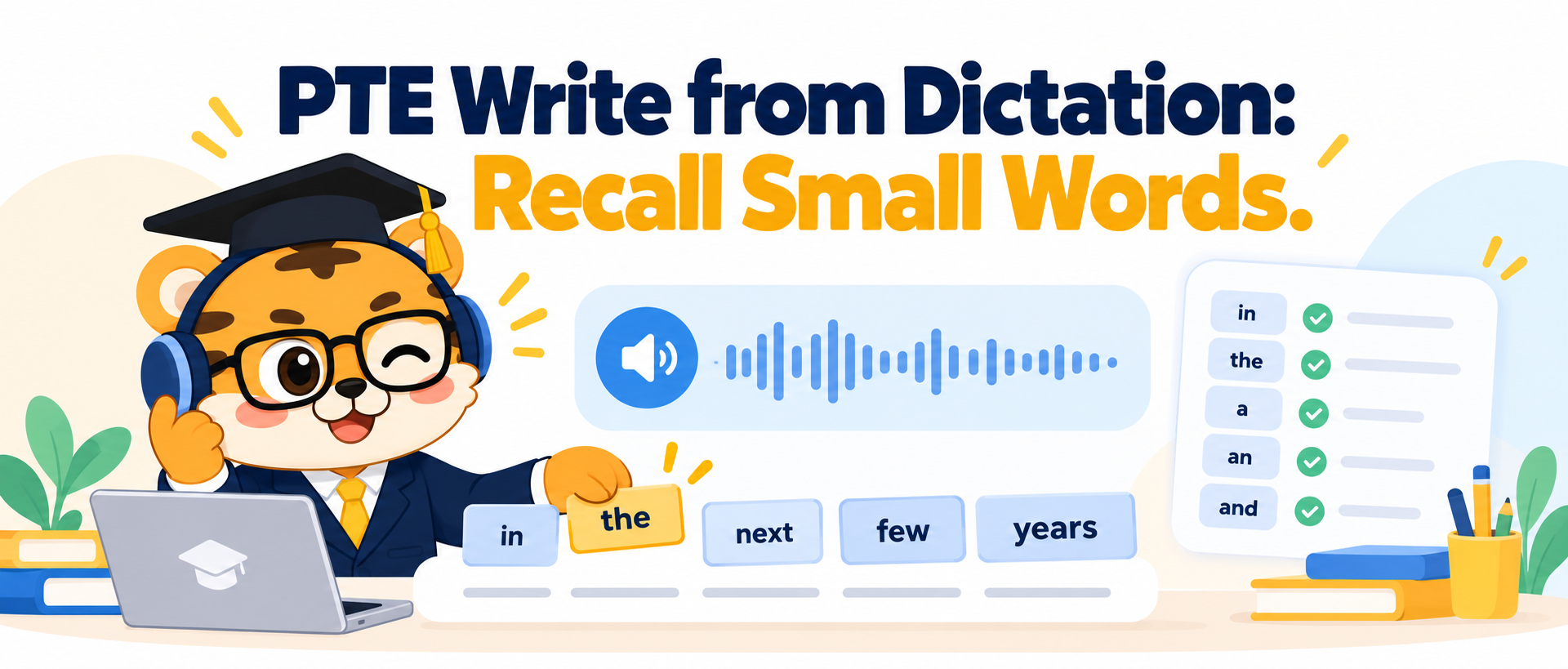
You may understand most of a PTE Write from Dictation sentence and still lose small words when you type it. An article disappears, a preposition gets dropped, or the final -s never makes it onto the screen. The meaning is close, but the sentence no longer matches what you heard.
One useful way to work on this is to separate recall from checking. First, hold the sentence in a few connected chunks. Then, after typing the main content, use grammar to review the positions of words you remember.
Grammar can help you check a recalled word. It should not become a reason to invent one.
Pearson’s current instructions say to type as many correct words as you can remember in the correct order. If you remember a word but are unsure where it belongs, English grammar can help you decide its position. That gives us a practical sequence: keep the sentence together, then inspect the small parts that are easy to miss.
01 Recall chunks so the sentence has a frame

If you remember only a handful of isolated content words, they can feel scrambled as soon as the audio stops. Chunks give those words temporary places. You might hold on to who is doing something, the action and its object, then a location or condition.
Take this practice sentence: The research team has published its findings in a journal. It can be grouped as The research team, has published, its findings, and in a journal.
This is a memory scaffold, not a fixed answer template. The audio remains the source of the words you type.
With chunks, you are no longer trying to assemble research, published, and journal from a pile of unrelated sounds. You remember a team, what it did, and where its work appeared. Once the sentence’s main frame is in place, small words have positions you can review.
During practice, you do not have to chase a perfect transcript in the first second. Write down the subject, verb, and nouns you clearly remember, then reconnect them as phrases.
You might first note team / published / findings / journal, and then recall whether you heard the, has, its, and in a. This lets you focus on memory before you focus on every letter.
There is a boundary here. Chunks help organize recall; they do not give you permission to rewrite the sentence based on what sounds familiar.
If you remember students / submitted / assignment, do not automatically add the just because English often uses it. Keep that word as a question to check. Include it when you remember the sound or can place a recalled word with grammatical support.
Keep the sentence as a few connected sounds first, then check the small words that are easy to overlook.
02 Leave a place for small words, then check grammar

Articles and prepositions can disappear from memory because they are short and often unstressed. Plural -s and verb endings are easy to miss for a similar reason. They may be brief in the audio, but they still affect whether the written response includes the right words.
Return to the practice sentence, The research team has published its findings in a journal. After typing the main structure, make one pass from left to right. Check whether a noun has a determiner before it, whether an auxiliary appears before the main verb, whether the noun sounds singular or plural, and whether a location phrase has a preposition.
Grammar works like a checklist here, not a word-making machine. If you remember findings but are unsure whether its came before it, use the sentence you recall and the determiner’s position to review it.
If you remember published but are unsure whether has came before it, check the subject and verb structure. If you still do not remember, do not treat a grammatically plausible word as something the recording definitely contained.
You can review endings in the same way. In The results have changed, results and have changed form a set of clues. In A student completed the form, the singular subject and past tense verb create another pattern.
Grammar can show you where to focus your recall, but the words you enter should still come from the audio.
A common mistake is to make the sentence too polished. You see a gap and add a; you prefer the plural and add s. The response may then contain a word the speaker never said.
Another mistake is spending so much effort spelling one word that you fail to keep the chunks you already heard. It helps to sort your notes into three groups: words you clearly heard, words whose position you roughly remember, and words you are not sure about.
Pearson’s task guidance says responses receive credit for correct, correctly spelled words in the correct order. Grammar can help place a word you remember. So the check is whether your recalled words fit back into the sentence, not whether you can edit the sentence into the English you expected.
03 Review against the sentence and turn errors into practice

After finishing an item, looking at the answer can create a quick feeling of recognition: right, that was it. A useful review goes one step further and asks why the word was missing. That gives you an action for your next practice set.
Compare your response with the sentence and sort missing words into four groups: a chunk you did not retain, a weak function word you did not hear, an ending you did not distinguish, or a spelling or typing slip.
If the main words are present but a and in are missing, focus on unstressed positions. If students keeps turning into student, pay attention to the final sound and the sentence’s number clues. If the word was in your memory but never reached the screen, practice entering certain words first and checking the line after.
Then do a short replay during practice. On the first listen, recall the chunks. On the next pass, compare them with the sentence and locate the gaps.
Finally, hide the answer and write it again. Replaying can help you diagnose sound details while studying, but the test item itself plays once, so bring practice back to listening once, writing, and checking.
A few carefully reviewed sentences can reveal more than a long set where you only record right or wrong. Keep each note short: did you miss the article because you focused only on stressed nouns, confuse a plural ending, or move on while typing? After a couple of days, the repeated type of error should become easier to spot.
If you want question-type practice and records in one place, YoushowPTE(优秀PTE) offers PTE listening practice, practice records, and learning data analysis.
You can work by question type and review your practice performance to plan what to focus on next. Visit the official YoushowPTE website.
When the next short sentence comes along, hold it in a few chunks, type the main frame, and check the grammar positions once. The small words do not need to be guessed into place. Leave room for them, recall what you heard, and review carefully.
If you enjoyed this article, feel free to give it a like. Thanks for reading, and see you next time.

AI-Powered PTE Preparation Journey
YoushowPTE provides AI smart scoring, massive real exam questions, and full mock exam system to help you pinpoint weaknesses, improve scores efficiently, and reach your target score with ease.
- AI Speaking & Writing Real-time Scoring
- High Hit-rate Real Question Bank
- Full Mock Exam Restores Real Test Experience
- Free Sign Up, Start Practicing Now